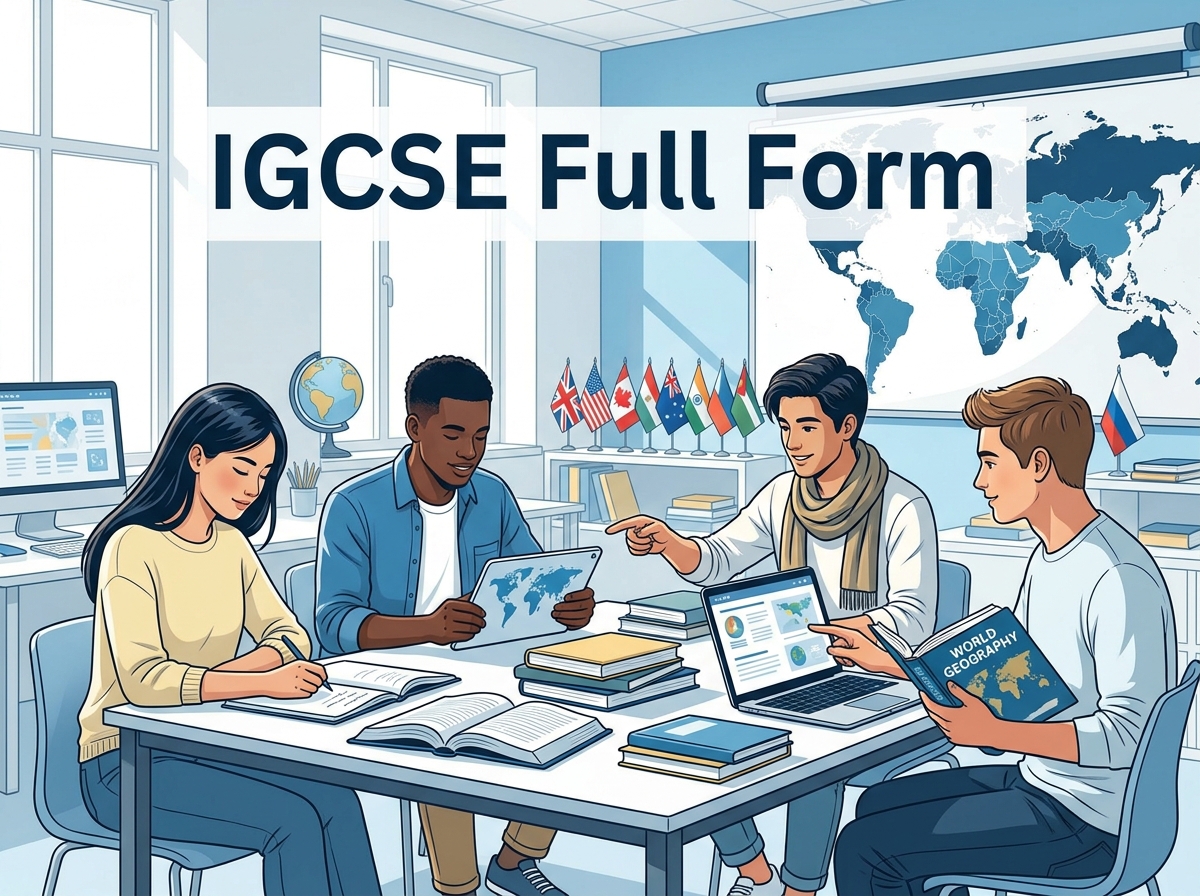
IGCSE is one of the most globally recognized secondary education qualifications, widely accepted by universities and employers across the world. It is known for its flexible curriculum and strong academic foundation.
IGCSE is an internationally standardized school qualification that prepares students for advanced academic pathways such as A-Levels, IB, and university education. It is designed to develop critical thinking, analytical skills, and subject expertise across a broad range of disciplines.
Quick Answer
The full form of IGCSE is International General Certificate of Secondary Education. It is an internationally recognized academic qualification offered by Cambridge Assessment International Education, designed for students aged 14–16. It focuses on developing subject knowledge, analytical thinking, and practical understanding across sciences, humanities, and languages for global higher education pathways.
Quick Facts About IGCSE 📊
| Category | Details |
|---|---|
| Full Form | International General Certificate of Secondary Education |
| Primary Industry/Field | Education / Secondary School Qualification |
| Year Introduced/Invented | 1988 |
| Core Purpose | Global secondary education certification for students aged 14–16 |
| Related Terms | Cambridge IGCSE, GCSE, A-Levels, International Curriculum |
What is International General Certificate of Secondary Education? A Complete Overview 🧠
The International General Certificate of Secondary Education is a globally recognized academic qualification designed for secondary school students. It is developed and administered by Cambridge Assessment International Education and is considered equivalent to national secondary education certificates in many countries.
IGCSE covers a wide range of subjects including Mathematics, English, Physics, Chemistry, Biology, Economics, ICT, and Humanities. The program emphasizes conceptual understanding rather than rote memorization, encouraging students to apply knowledge in practical and real-world contexts.
One of the key strengths of IGCSE is its flexibility. Students can choose subjects based on their interests and future career goals, allowing for personalized academic pathways. The curriculum is designed to prepare learners for advanced studies such as A-Levels, IB Diploma, and other international qualifications.
The History and Evolution of IGCSE 📜
IGCSE was introduced in 1988 by Cambridge Assessment International Education as an international alternative to the UK-based GCSE system. The goal was to create a curriculum that could be adapted for students worldwide while maintaining academic rigor.
Initially, it was designed primarily for international schools outside the United Kingdom. However, due to its structured approach and global recognition, it quickly gained popularity in countries across Asia, the Middle East, and Africa.
In the 1990s and 2000s, the curriculum expanded significantly, introducing more subjects and updating syllabi to reflect modern educational needs. Technology-based subjects like Computer Science and ICT were added to align with global digital transformation.
Today, IGCSE is recognized by universities and employers worldwide and continues to evolve with updated assessment methods, skill-based learning models, and digital examination systems in some regions.
How Does IGCSE Work? (Core Mechanism) ⚙️
The IGCSE system operates through a structured academic and assessment framework:
- Students enroll in an IGCSE program through registered schools or institutions.
- They select a combination of subjects based on curriculum requirements and personal interests.
- Each subject follows a detailed syllabus designed by Cambridge International.
- Teaching is delivered through classroom instruction, practical labs, and project-based learning.
- Students are assessed through written examinations, coursework, and practical evaluations.
- Final grades are awarded based on a grading scale from A* to G (or 9–1 in updated systems).
- Results are issued internationally and accepted for further academic progression.
This structured process ensures consistent academic standards across all countries offering the qualification.
Types or Categories of IGCSE 🗂️
IGCSE subjects and study paths are categorized based on academic streams:
- Core Subjects
Includes English, Mathematics, and Sciences, forming the foundation of the curriculum for all students. - Extended Subjects
Advanced versions of core subjects designed for students aiming for higher academic achievement. - Humanities and Social Sciences
Subjects like History, Geography, Economics, and Sociology that focus on society and human behavior. - Sciences and Technical Subjects
Includes Physics, Chemistry, Biology, ICT, and Computer Science with laboratory and practical components. - Creative and Vocational Subjects
Art & Design, Music, Business Studies, and Design Technology focusing on creativity and applied skills.
Advantages and Disadvantages of IGCSE ⚖️
| Advantages | Disadvantages |
|---|---|
| Globally recognized qualification | Can be academically demanding for some students |
| Flexible subject selection | Expensive in some international schools |
| Strong focus on analytical skills | Requires high level of English proficiency |
| Prepares students for A-Levels and IB | Heavy exam-based assessment structure |
| Accepted by top universities worldwide | Limited availability in some regions |
Real-World Applications and Uses 🌍
IGCSE is not just an academic certificate; it plays a key role in shaping future education and career paths.
- University Admissions
IGCSE is widely accepted by universities as a foundational qualification for entry into A-Levels, IB Diploma, and undergraduate programs. - International Career Pathways
Students with IGCSE qualifications often pursue global education systems, making it easier to study or work abroad. - STEM Education Preparation
Subjects like Physics, Chemistry, and Computer Science prepare students for engineering, medicine, and technology-related fields. - Business and Economics Foundation
IGCSE Business Studies and Economics provide early exposure to financial systems and global markets. - Language and Communication Development
Strong emphasis on English and additional languages improves communication skills for global careers.
Other Meanings of IGCSE (Alternative Full Forms) 🔄
| Context/Industry | Full Form | Brief Definition |
|---|---|---|
| Education | International General Certificate of Secondary Education | International secondary school qualification |
| Informal Misuse | IGCSE | Sometimes mistakenly expanded differently in local contexts |
| Academic Reference | Independent General Curriculum Secondary Education | Rare unofficial interpretation in some regions |
| Institutional Use | International General Certificate for School Education | Alternate phrasing used in educational discussions |
Frequently Asked Questions ❓
1. What is the main purpose of IGCSE?
The main purpose of IGCSE is to provide a globally recognized secondary education qualification that prepares students for advanced academic studies and international careers.
2. Is IGCSE equivalent to GCSE?
Yes, IGCSE is considered equivalent to the UK’s GCSE, but it is designed for international students with a more global curriculum approach.
3. Which board conducts IGCSE?
IGCSE is primarily conducted by Cambridge Assessment International Education, with some versions also offered by Edexcel.
4. What age group is IGCSE for?
IGCSE is generally designed for students aged 14 to 16 years, typically in Grades 9 and 10.
5. Is IGCSE difficult?
IGCSE can be challenging due to its analytical and application-based learning style, but it builds strong academic foundations.
6. What comes after IGCSE?
After IGCSE, students usually progress to A-Levels, IB Diploma, or other advanced pre-university programs.
7. Is IGCSE accepted worldwide?
Yes, IGCSE is widely accepted by universities and educational institutions across Europe, Asia, the Middle East, and other regions.
About the Author