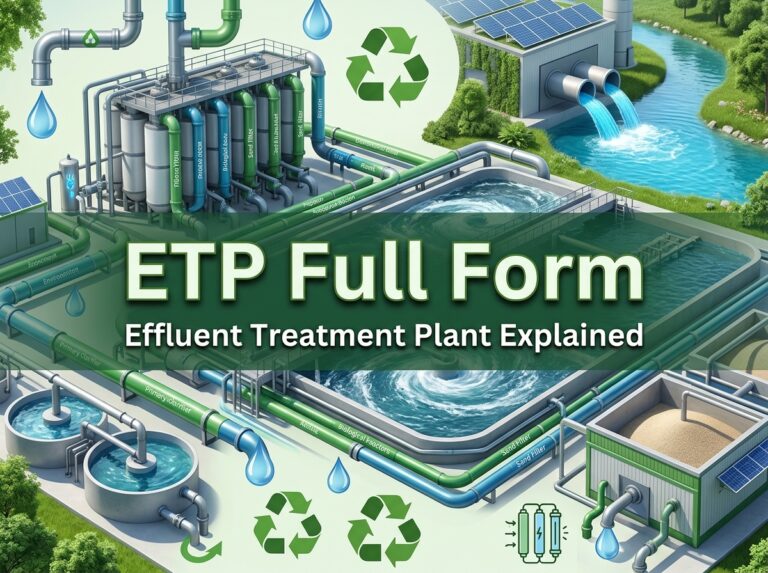
Industrial growth and environmental protection must go hand in hand, making wastewater treatment one of the most important processes in modern manufacturing. Understanding the ETP full form helps students, engineers, environmental professionals, and business owners appreciate how industries manage wastewater before releasing it into the environment.
Quick Answer: The full form of ETP is Effluent Treatment Plant. It is an industrial wastewater treatment system designed to remove physical, chemical, and biological contaminants from effluents before discharge or reuse. ETPs are widely used in manufacturing, pharmaceuticals, textiles, food processing, and chemical industries to meet environmental regulations and reduce pollution.
Quick Facts About ETP 📊
| Feature | Details |
|---|---|
| Full Form | Effluent Treatment Plant |
| Primary Industry/Field | Environmental Engineering |
| Year Introduced/Invented | Early 20th Century Industrial Treatment Systems |
| Core Purpose | Treating industrial wastewater before discharge |
| Related Terms | STP, Wastewater Treatment, Water Recycling, Sewage Treatment, Industrial Effluent |
What is Effluent Treatment Plant? A Complete Overview 🧠
An Effluent Treatment Plant (ETP) is a specialized facility designed to treat wastewater generated by industrial processes. Unlike domestic sewage, industrial wastewater often contains hazardous chemicals, oils, heavy metals, toxic substances, dyes, and other pollutants that can seriously damage ecosystems if discharged untreated.
The primary objective of an ETP is to remove contaminants from industrial effluents and ensure that the treated water meets environmental standards established by regulatory authorities. Once treated, the water can either be safely released into natural water bodies or reused within industrial operations.
Industries such as textile manufacturing, pharmaceuticals, petrochemicals, paper mills, food processing plants, and chemical factories generate large quantities of wastewater every day. Without proper treatment systems, these effluents can contaminate rivers, lakes, groundwater resources, and agricultural land.
Modern ETPs use a combination of physical, chemical, and biological treatment methods. Each stage targets specific pollutants, ensuring comprehensive purification. The complexity of an ETP depends on the nature of the wastewater and the industry producing it.
Environmental sustainability has made ETPs a critical component of industrial infrastructure worldwide. Many governments require industries to install and operate ETPs to minimize environmental damage and comply with pollution control regulations.
The History and Evolution of ETP 📜
The concept of wastewater treatment dates back centuries, but industrial effluent treatment became increasingly important during the Industrial Revolution. As factories expanded, wastewater generation increased dramatically, creating severe pollution problems in urban and industrial regions.
In the late nineteenth and early twentieth centuries, basic treatment systems were introduced to remove solid waste and suspended particles from industrial wastewater. However, these early systems were often insufficient for handling complex chemical contaminants.
As environmental awareness grew during the mid-twentieth century, governments introduced stricter regulations governing wastewater discharge. This led to significant advancements in treatment technologies and the development of modern ETP systems.
Several milestones contributed to the evolution of ETPs:
• Introduction of biological treatment processes
• Development of advanced chemical treatment techniques
• Adoption of activated sludge systems
• Integration of membrane filtration technologies
• Implementation of automated monitoring systems
• Introduction of zero liquid discharge systems
Today, modern ETPs utilize sophisticated sensors, automation software, advanced filtration systems, and energy-efficient treatment technologies. Many facilities now focus not only on pollution control but also on water recovery and resource conservation.
How Does ETP Work? (Core Mechanism) ⚙️
An Effluent Treatment Plant follows a systematic process to remove contaminants from industrial wastewater.
1. Collection and Screening
Wastewater from various industrial operations is collected in holding tanks. Large debris, plastics, rags, and other solid materials are removed through screening equipment.
2. Equalization
The wastewater enters an equalization tank where flow rates and pollutant concentrations are balanced. This creates a consistent treatment environment and prevents sudden fluctuations.
3. pH Adjustment
Industrial wastewater often contains acidic or alkaline substances. Chemicals are added to maintain an optimal pH level for effective treatment.
4. Coagulation and Flocculation
Special chemicals known as coagulants and flocculants are added to combine fine suspended particles into larger clusters called flocs, making them easier to remove.
5. Primary Sedimentation
The wastewater is transferred to sedimentation tanks where heavy particles settle at the bottom while lighter materials float to the surface.
6. Biological Treatment
Microorganisms break down dissolved organic pollutants through biological processes. This stage significantly reduces organic contamination.
7. Secondary Clarification
Additional suspended solids generated during biological treatment are separated from the water.
8. Filtration
Water passes through sand filters, activated carbon filters, or membrane systems to remove remaining impurities.
9. Disinfection
Ultraviolet light, chlorine, or ozone may be used to eliminate harmful microorganisms.
10. Discharge or Reuse
The treated water is either safely discharged into the environment or recycled for industrial applications.
Types or Categories of ETP 🗂️
Different industries require different treatment approaches based on wastewater characteristics.
Physical Treatment ETP
Physical treatment methods focus on removing suspended solids and floating materials through screening, sedimentation, filtration, and flotation processes.
Chemical Treatment ETP
Chemical treatment involves using chemicals to neutralize contaminants, adjust pH levels, and remove dissolved pollutants.
Biological Treatment ETP
Biological treatment utilizes microorganisms to decompose organic matter naturally, making it one of the most environmentally friendly treatment methods.
Combined ETP
Most modern facilities use a combination of physical, chemical, and biological treatments to achieve maximum efficiency.
Zero Liquid Discharge ETP
Zero Liquid Discharge systems recover nearly all wastewater for reuse, minimizing environmental discharge and maximizing water conservation.
Advanced Membrane-Based ETP
These systems use technologies such as:
• Reverse Osmosis
• Ultrafiltration
• Nanofiltration
• Microfiltration
They provide exceptionally high-quality treated water.
Advantages and Disadvantages of ETP ⚖️
| Advantages | Disadvantages |
|---|---|
| Reduces environmental pollution | High installation costs |
| Ensures regulatory compliance | Requires skilled operators |
| Enables water reuse | Ongoing maintenance expenses |
| Protects aquatic ecosystems | Energy consumption can be significant |
| Removes toxic contaminants | Complex systems may require frequent monitoring |
| Improves corporate sustainability | Sludge disposal challenges |
| Conserves freshwater resources | Initial setup may require substantial space |
Real World Applications and Uses 🌍
Textile Industry
Textile factories generate wastewater containing dyes, chemicals, detergents, and bleaching agents. ETPs remove color, suspended solids, and chemical pollutants before discharge.
Proper treatment prevents contamination of nearby rivers and protects aquatic life from harmful substances.
Pharmaceutical Manufacturing
Pharmaceutical companies produce wastewater containing active pharmaceutical ingredients, solvents, and chemical residues.
Advanced ETP systems ensure that these contaminants are effectively removed before wastewater enters public water systems.
Food and Beverage Industry
Food processing facilities generate wastewater rich in organic matter, oils, fats, and suspended solids.
ETPs help reduce biological oxygen demand and maintain environmental compliance while enabling water recycling.
Chemical and Petrochemical Plants
Chemical manufacturing facilities often produce highly contaminated wastewater containing hazardous compounds.
Specialized ETPs use advanced treatment methods to neutralize toxic substances and reduce environmental risks.
Paper and Pulp Industry
Paper mills generate wastewater containing fibers, organic compounds, and bleaching chemicals.
ETPs remove these pollutants and support sustainable manufacturing practices by promoting water reuse.
Other Meanings of ETP (Alternative Full Forms) 🔄
| Context/Industry | Full Form | Brief Definition |
|---|---|---|
| Environmental Engineering | Effluent Treatment Plant | Facility for treating industrial wastewater |
| Finance | Exchange Traded Product | Financial instrument traded on stock exchanges |
| Education | Education and Training Program | Structured learning and development program |
| Healthcare | Emergency Treatment Protocol | Guidelines for emergency medical treatment |
| Information Technology | Enterprise Technology Platform | Integrated technology infrastructure |
| Telecommunications | Electronic Transfer Process | Digital data transfer system |
| Manufacturing | Engineering Test Procedure | Method used to evaluate products |
| Energy | Energy Trading Platform | Market system for buying and selling energy |
| Government | Employment Transition Program | Workforce transition initiative |
| Logistics | Export Trade Promotion | Activities supporting international trade |
| Military | Equipment Testing Program | Program for evaluating equipment performance |
| Aviation | Electronic Ticketing Process | Digital ticket management system |
Frequently Asked Questions ❓
What is the full form of ETP?
The full form of ETP is Effluent Treatment Plant. It is a wastewater treatment facility designed to remove pollutants from industrial effluents before discharge or reuse.
What is the difference between ETP and STP?
An ETP treats industrial wastewater containing chemicals and industrial pollutants, while an STP treats domestic sewage generated from residential and commercial areas.
Why is an ETP important?
An ETP protects the environment by preventing untreated industrial wastewater from entering natural water bodies. It also helps industries comply with environmental regulations.
Which industries require ETP systems?
Industries such as textiles, pharmaceuticals, chemicals, food processing, petrochemicals, paper manufacturing, and metal processing commonly require ETP systems.
Can treated ETP water be reused?
Yes. Many industries reuse treated ETP water for cooling, cleaning, gardening, boiler operations, and manufacturing processes, reducing freshwater consumption.
What are the major stages of an ETP?
The main stages include screening, equalization, pH adjustment, coagulation, sedimentation, biological treatment, filtration, disinfection, and final discharge or reuse.
What is Zero Liquid Discharge in ETP?
Zero Liquid Discharge is an advanced wastewater management approach where nearly all wastewater is recovered and reused, leaving minimal or no liquid waste for disposal.
Conclusion 🎯
The ETP full form is Effluent Treatment Plant, a critical environmental protection system used to treat industrial wastewater before discharge or reuse. By combining physical, chemical, and biological treatment processes, ETPs help industries reduce pollution, conserve water resources, and comply with environmental regulations. As sustainability becomes increasingly important, modern ETP technologies continue to evolve, enabling industries to operate more responsibly while protecting ecosystems and public health.
About the Author