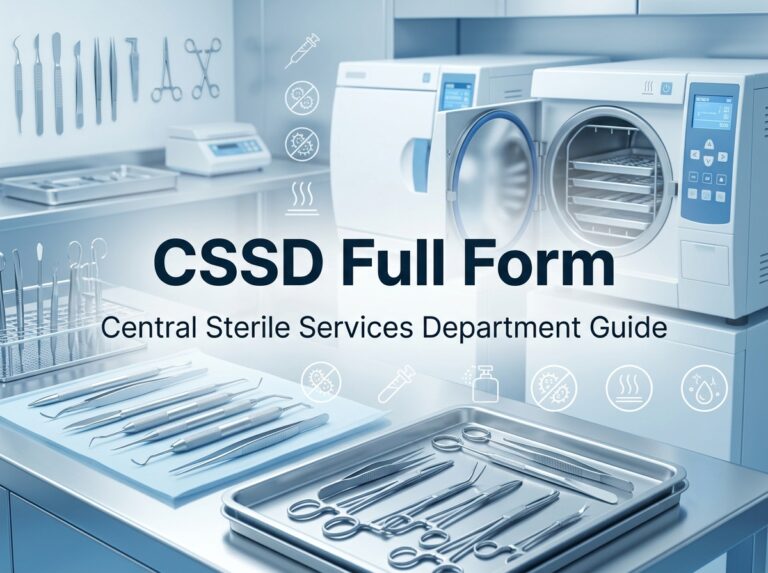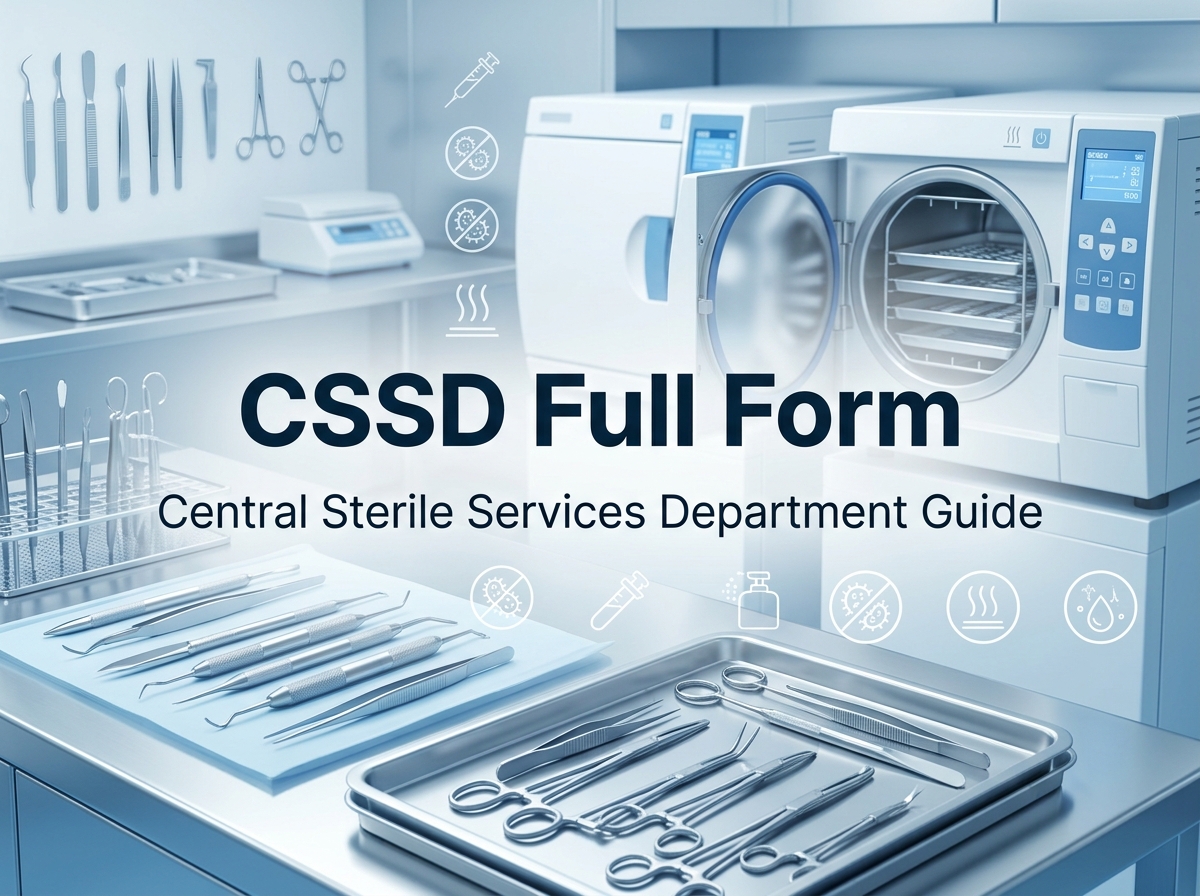
In modern healthcare, patient safety depends heavily on proper sterilization and infection control. Understanding the CSSD full form is essential for healthcare students, medical professionals, and anyone interested in hospital operations because this department plays a critical role in preventing infections and ensuring safe medical procedures.
Quick Answer: The full form of CSSD is Central Sterile Services Department. It is a specialized hospital unit responsible for cleaning, disinfecting, sterilizing, storing, and distributing medical instruments and equipment. CSSD serves as the backbone of infection control by ensuring that reusable healthcare devices are safe for patient use.
Quick Facts About CSSD 📊
| Feature | Details |
|---|---|
| Full Form | Central Sterile Services Department |
| Primary Industry/Field | Healthcare and Hospital Management |
| Year Introduced/Invented | Formalized during the mid 20th century |
| Core Purpose | Sterilization and infection prevention |
| Related Terms | Sterilization, Infection Control, Autoclave, Medical Equipment Processing, Hospital Hygiene |
What is Central Sterile Services Department? A Complete Overview 🧠
The Central Sterile Services Department, commonly known as CSSD, is a dedicated hospital department responsible for processing reusable medical instruments and equipment. Every surgical tool, medical device, dressing tray, and reusable instrument used in healthcare facilities must undergo strict sterilization procedures before being used on patients.
CSSD serves as the central hub for infection prevention within hospitals. Rather than allowing individual departments to sterilize equipment independently, healthcare facilities centralize these processes within CSSD to ensure consistency, quality control, and compliance with healthcare standards.
The department handles thousands of instruments daily in large hospitals. Surgical scissors, forceps, clamps, endoscopic tools, orthopedic instruments, and numerous other devices pass through CSSD before reaching operating rooms and clinical departments.
Sterilization is not simply cleaning. Even visually clean instruments can contain microorganisms capable of causing infections. CSSD employs scientifically validated processes that destroy bacteria, viruses, fungi, and microbial spores to ensure complete safety.
Healthcare accreditation organizations worldwide consider an efficient CSSD essential for maintaining patient safety standards and reducing healthcare associated infections.
The History and Evolution of CSSD 📜
Before centralized sterilization departments existed, hospitals often sterilized instruments within individual wards and operating rooms. This decentralized approach led to inconsistencies in sterilization quality and increased infection risks.
The development of modern surgical practices during the nineteenth century highlighted the importance of sterile instruments. Advances in microbiology and infection control transformed healthcare practices significantly.
The pioneering work of scientists such as Louis Pasteur and Joseph Lister demonstrated the connection between microorganisms and infection, encouraging hospitals to adopt more rigorous sterilization methods.
During the mid twentieth century, healthcare institutions began establishing centralized sterilization units. This transition offered several advantages:
• Standardized sterilization procedures
• Improved quality control
• Better equipment management
• Enhanced staff specialization
• Reduced infection risks
• Increased operational efficiency
Technological advancements further revolutionized CSSD operations. Modern departments now use automated washers, advanced sterilizers, tracking systems, barcode technology, and digital monitoring tools.
Today, CSSD has evolved into a highly specialized healthcare function governed by strict national and international standards.
How Does CSSD Work? (Core Mechanism) ⚙️
CSSD follows a systematic workflow to ensure medical instruments are properly sterilized and safe for patient use.
1. Collection of Used Instruments
After medical procedures, used instruments are collected from operating rooms, emergency departments, wards, and clinics.
2. Transportation to CSSD
The contaminated instruments are transported safely in designated containers to prevent exposure and cross contamination.
3. Decontamination
Instruments undergo preliminary cleaning to remove:
• Blood
• Tissue residues
• Body fluids
• Organic debris
This stage is essential because sterilization cannot be effective if contaminants remain on instrument surfaces.
4. Inspection and Sorting
Technicians inspect instruments for:
• Damage
• Corrosion
• Functionality issues
• Missing components
Any defective items are repaired or removed from circulation.
5. Packaging
Clean instruments are assembled into procedure specific sets and packaged using sterilization compatible materials.
6. Sterilization
The packaged instruments undergo sterilization through approved methods such as steam sterilization, gas sterilization, or low temperature sterilization.
7. Quality Assurance
Biological indicators, chemical indicators, and monitoring systems verify sterilization effectiveness.
8. Storage
Sterile instruments are stored under controlled conditions to maintain sterility.
9. Distribution
The sterilized equipment is delivered to departments where it will be used for patient care.
Types or Categories of CSSD 🗂️
CSSD operations can be categorized based on processing methods and healthcare requirements.
Steam Sterilization Section
This area uses pressurized steam to eliminate microorganisms. It is one of the most effective and widely used sterilization methods.
Ethylene Oxide Sterilization Section
Sensitive medical devices that cannot tolerate high temperatures are processed using ethylene oxide gas.
Low Temperature Sterilization Unit
Specialized equipment such as delicate electronic medical instruments may require low temperature sterilization technologies.
Instrument Processing Section
This section focuses on cleaning, inspecting, assembling, and packaging reusable instruments.
Sterile Storage Unit
Sterilized equipment is stored in controlled environments until needed for patient care.
Quality Control Division
This area ensures compliance with sterilization standards through testing, monitoring, documentation, and validation procedures.
Advantages and Disadvantages of CSSD ⚖️
| Advantages | Disadvantages |
|---|---|
| Improves patient safety | High setup costs |
| Reduces healthcare associated infections | Requires specialized training |
| Standardizes sterilization procedures | Equipment maintenance can be expensive |
| Enhances hospital efficiency | Continuous monitoring is necessary |
| Supports regulatory compliance | Space requirements can be significant |
| Improves instrument lifespan | Technology upgrades may be costly |
| Ensures quality control | Staff shortages can affect operations |
Real World Applications and Uses 🌍
Hospitals and Surgical Centers
The primary application of CSSD is in hospitals and surgical facilities. Every surgical procedure depends on sterilized instruments prepared and distributed by CSSD professionals.
Without effective sterilization, surgical site infections could increase significantly.
Dental Clinics
Dental practices use numerous reusable instruments during treatments. CSSD principles help ensure these tools remain sterile between patient appointments.
Proper instrument processing protects both patients and healthcare providers.
Specialized Healthcare Facilities
Facilities focused on cardiology, orthopedics, ophthalmology, and other specialties require highly specialized instruments.
CSSD departments manage the sterilization of these valuable and often complex devices.
Ambulatory Care Centers
Outpatient surgical centers perform procedures that require strict infection control measures.
CSSD operations support safe and efficient patient care in these environments.
Medical Research Institutions
Research laboratories and teaching hospitals use CSSD processes to maintain sterile environments for scientific investigations and clinical training programs.
Sterilized equipment ensures accurate research outcomes and safe educational experiences.
Other Meanings of CSSD (Alternative Full Forms) 🔄
| Context/Industry | Full Form | Brief Definition |
|---|---|---|
| Healthcare | Central Sterile Services Department | Hospital sterilization and infection control unit |
| Education | Curriculum Support and Staff Development | Academic support and professional training division |
| Information Technology | Computer Systems Software Development | Software design and development activities |
| Business | Customer Service Solutions Division | Department focused on customer support services |
| Government | Community Safety and Service Department | Public service and safety administration unit |
| Engineering | Control Systems and Signal Design | Engineering discipline focused on system controls |
| Telecommunications | Communication Systems Service Division | Communications infrastructure management unit |
| Manufacturing | Central Supply and Storage Department | Inventory and material management department |
| Research | Clinical Study Support Division | Unit supporting medical research activities |
| Logistics | Cargo Scheduling and Service Department | Transportation and logistics coordination center |
| Finance | Corporate Strategy and Systems Development | Business planning and systems improvement division |
| Defense | Combat Support Services Division | Military operational support department |
Frequently Asked Questions ❓
What is the full form of CSSD?
The full form of CSSD is Central Sterile Services Department. It is a hospital department responsible for cleaning, sterilizing, storing, and distributing medical instruments.
Why is CSSD important in hospitals?
CSSD helps prevent healthcare associated infections by ensuring all reusable medical equipment is properly sterilized before patient use. It is a vital component of patient safety and infection control.
What are the main functions of CSSD?
The primary functions include cleaning, decontamination, inspection, packaging, sterilization, storage, quality assurance, and distribution of medical instruments.
Who works in a CSSD department?
CSSD departments employ sterile processing technicians, supervisors, quality control specialists, infection control professionals, and hospital support staff.
What equipment is used in CSSD?
Common equipment includes autoclaves, washer disinfectors, ultrasonic cleaners, sealing machines, sterilization containers, and monitoring systems.
What is the difference between cleaning and sterilization?
Cleaning removes visible dirt and contaminants, while sterilization destroys all forms of microbial life, including bacterial spores and resistant microorganisms.
Is CSSD a good career option?
Yes. The growing emphasis on infection prevention, patient safety, and healthcare quality has increased demand for trained CSSD professionals in hospitals and healthcare facilities worldwide.
Conclusion 🎯
The CSSD full form is Central Sterile Services Department, a critical hospital unit dedicated to sterilization, infection control, and patient safety. By managing the cleaning, inspection, sterilization, storage, and distribution of medical instruments, CSSD ensures that healthcare providers have safe and reliable equipment for patient care. As healthcare standards continue to advance, the importance of CSSD professionals and modern sterilization systems will only continue to grow.
About the Author